
 June 6, 2026 "Upper Red Lake Fishing Report"
 Upper Red Lake water temperatures are on the rise, this Friday, we found readings of 69 degrees in several regions of the lake. Sunshine, along with warmer water has worked their magic on the lake’s vegetation. Pockets of sparse, low growing plants now hold shiners and small baitfish which have completed their spawning runs. With baitfish holding in the sparse cover, predators are in position and feeding.
Rocks and patches of gravel provide cover too, and there are minnows, along with predators milling around in the shadows; also feeding.
I fished at the big lake twice last week, once with the Higgins brothers crew on Wednesday and again yesterday with Bill and Steve. For the most part, presentations and fish locations were similar. There were subtle changes though, and it felt to me like there’s a seasonal transition on tap in the coming days.
The reason I say the transition is coming is because the presence of freshwater drum, aka sheepshead, intensified on Friday. We caught 2 of them, the first I’d seen this year, and we also saw other boats catch some of them too. In my experience, as the sheepshead move into the shallows, the walleye population begins thinning out. There are always some fish that remain in the shallow water, but the schools become smaller, and they spread out further around the shoreline.
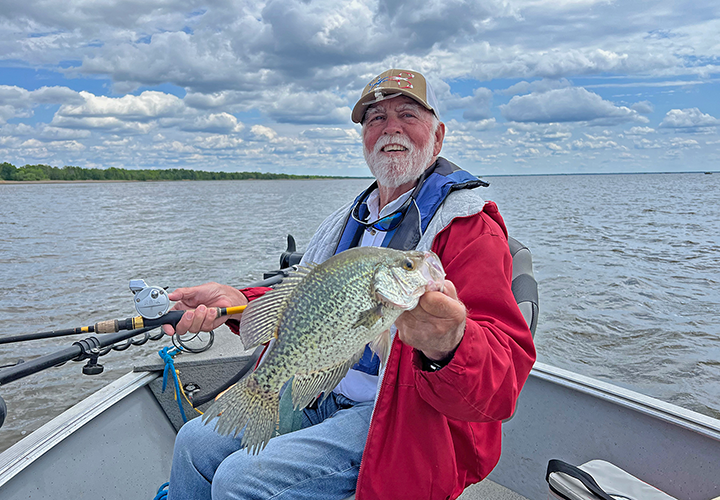
 Another change was the capture by Bill Norengerg of a crappie, pictured above. This was the first one that any of my customers caught this year. The spot, a small patch of weeds that I think are called Whorled Watermilfoil, (Myriophyllum Verticillatum) holds crappies almost every summer. Over the past few seasons, it’s been common for my customers to catch 2 or 3 of them on almost every visit, the best we’ve done was 7 crappies one day back in 2024. Obviously, that doesn’t make the spot a crappie destination, but for crappies like the one pictured here are present, it’s worth checking out when we’re in the area.
If you’re fishing the shoreline and encounter patches of the wispy, coontail like plants, I’d suggest keeping track of them and fishing them whenever you can. Sometimes, walleyes hang out in the gaps between the bushy looking plants too, and there’s always a chance of catching a larger northern pike using the cover too.
One more sign that the ecosystem is changing was how the fish responded to various presentations. Earlier this season I had a formula that was reliable and worked well every time I tried it; until yesterday.
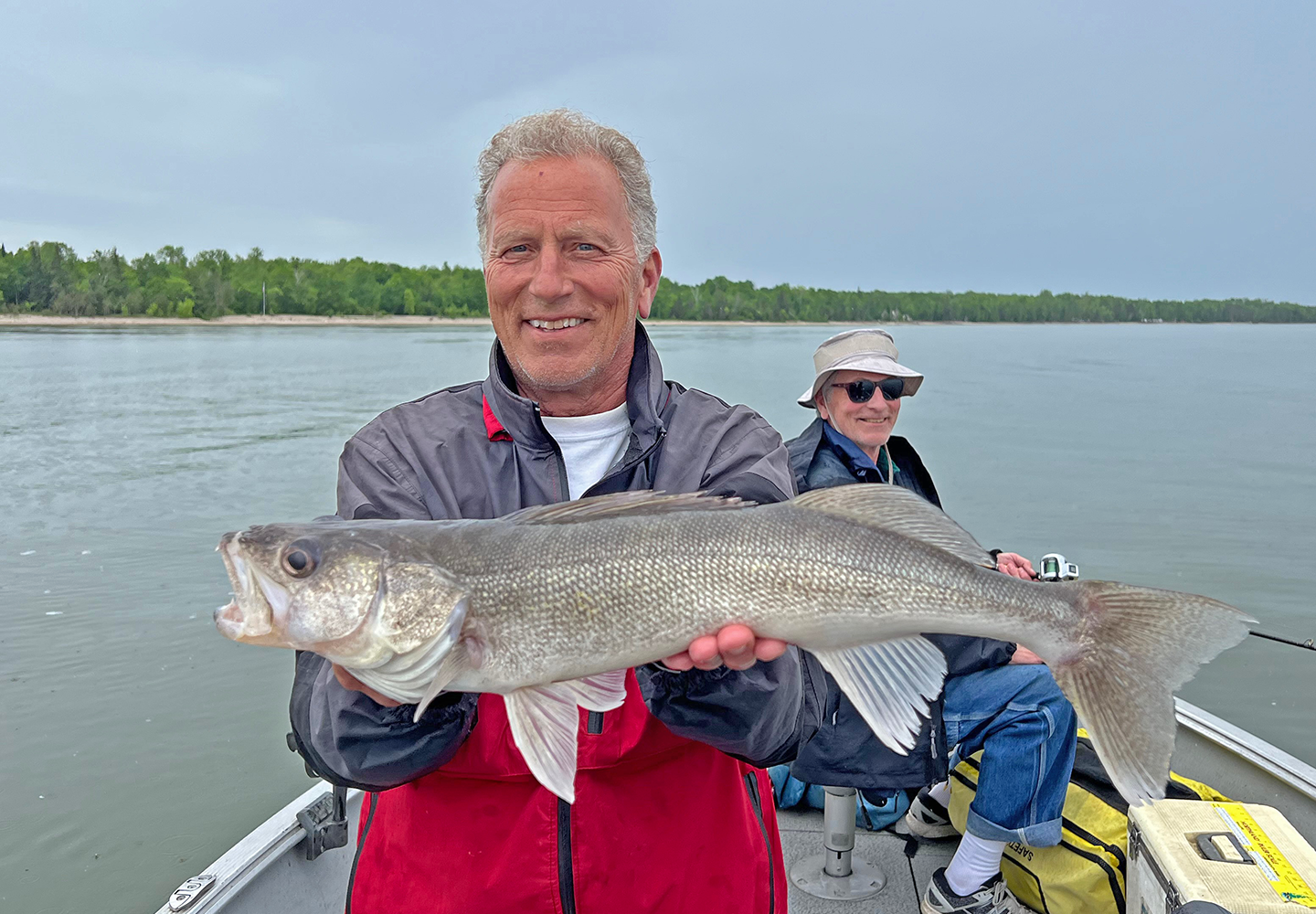
The formula, using crankbaits to catch larger walleyes, and trolling spinners to gather eating size fish worked like a charm. In fact, last Wednesday, Matt Higgins proved the theory by catching this large walleye. At nearly 24 inches, it was one of the largest examples that any of my customers have caught. On the same trip, we caught many other walleyes in the 17-to-20-inch range and on another recent trip, crank baiting produced only slot fish and almost zero small ones.
 After we’d had our fun catching larger walleyes, when we needed eaters, I’d re-rig with spinners and begin trolling the same structures. Like magic, smaller fish responded to the spinners and alternating the presentations gave us everything we wanted. By the end of every trip, we had plenty of eaters, along with a few nice photos.
Yesterday, that pattern was broken, both presentations worked, but there was little, if any difference between the sizes of fish they produced. In fact, we caught larger fish using the spinners than we did by trolling crankbaits. The results of my experience are obviously subjective, and you may have other observations. The point is that whatever is happening, there has been a change in the pattern.
Jigs and minnows, another mainstay presentation on Upper Red was working on Friday too. We saw the anglers in numerous boats drifting and jigging and catching fish. Occasionally, we checked in with some of them and most reported having satisfactory results. For me, jigging is the most fun, but for my customers, the trolling presentations require less intensity. I’d say that whatever your preferred presentation is, you’ll probably catch some fish with it.
Key depths vary from spot-to-spot but if you focus on the range from 3 to 6 feet of water, you will encounter some walleyes. For me, the key depth range has been 3.5 to 4.5 feet along the drop off from the shallowest flats into the first break into deeper water. In that shallow water, the lures are trolled very close to the boat. I’ve been using line counter reels for accuracy and trolling spinners at 16 feet behind the boat. For crankbaits, 5 Berkley Flicker Shads were setting the reels to keep our lures 26 feet behind the boat.
“I can’t believe that we’re trolling so close to the boat,” Bill said yesterday. I know it does sound incredible, but in the turbid water, the Red Lake walleyes are very willing to strike, even when the lures are barely out of the boat’s prop wash.
Okay, that’s the Red Lake update, at least as much as I have time to offer this morning. I’d love to hear your thoughts about your recent experiences on the big lake. Remember too, I’m always happy to answer questions. So, if I leave out any details, be sure to drop a line and ask for clarification. Have a fabulous weekend on the lake and be sure to check in again soon.  — Jeff Sundin, The Early Bird Fishing Guide Call-Text 218-245-9858 • Email • Facebook • X • Subscribe Insider Newsletter
More Recent Fishing Reports
Follow on X • Follow on Facebook • L.O.W 6-09 • Upper Red lake 6-6 • Lake Winnie 6-5 • Ely MN 6-3 • L.O.W 6-3 • Sundin 6-2 • Upper Red Lake 6-1 • Walleye Report 5-31 • Upper Red Lake 5-29 • Lake Winnie 5-28 • L.O.W. 5-27 • Ely MN 5-27 • Sundin 5-26 • Upper Red Lake 5-23 • Winnibigoshish 5-21 • Ely MN 5-20 • L.O.W 5-20 • Winnie 5-20 • Upper Red Lake 5-15 • Lake Winnie 5-14 • Sundin 5-12 • MN Walleye Opener 5-10 • Rainy River 5-6 • Crappies 5-4 • Cutfoot Sioux Walleye Spawning • Justin Chromy • 3-6 Mille Lacs Open Water Walleye Limit • 3-5 MN Walleye Limit Reduction • Schara Walleye Limits • Walleye Limit 2-1 • Walleye Limit 1-27 • IOWA Limits 1-23 • 1-22 Walleye Limits • Gary Barnard 11-11 • Technology 10-25 • Charts 1-23-25 • MAPS 1-22-23 • Barotrauma Study 1-25-24 • Fish Consumption • Forward Sonar • Panfish Workgroup
 KAXE KBXE Radio News Release June 2026 "Red Lake Nation Returns Roseau Pilot's Vintage Airplane"
 "The dispute drew the attention of international media and pilots' associations, raising concerns about the rights of distressed pilots while making emergency landings.
After more than seven months, the Red Lake Nation returned a vintage aircraft to a Roseau pilot Wednesday, June 3. The plane went down Oct. 15, 2025, after an engine failure above Lower Red Lake while en route to Bemidji at about 3,500 feet.
No one was injured in the emergency landing, but Red Lake Tribal Police impounded Darrin Smedsmo’s airplane on the grounds the landing violated the band’s airspace rules as well as endangered public safety.
The issue gained the attention of international media and pilots associations, particularly regarding the rights of pilots when making emergency landing decisions. “I think justice prevailed, cooler heads prevailed,” Smedsmo said in a Thursday phone interview. “It took a while, took longer than it should have, but I am pleased.”
The Red Lake Nation had a 1978 resolution that barred any aircraft flying below 20,000 feet — to oppose proposed low-flying military exercises in the area — following the Cold War-era military tests around the Big Bog Recreation Area in Waskish. In an announcement last November, the Red Lake Tribal Council stated it welcomed the ..." Listen to the Full Story >> Red Lake Nation Returns Roseau Pilot's Vintage Airplane
Today's Feature Fishing Report: Jeff Sundin - May 29, 2026 "Jeff Sundin Upper Red Lake Walleyes and More!"
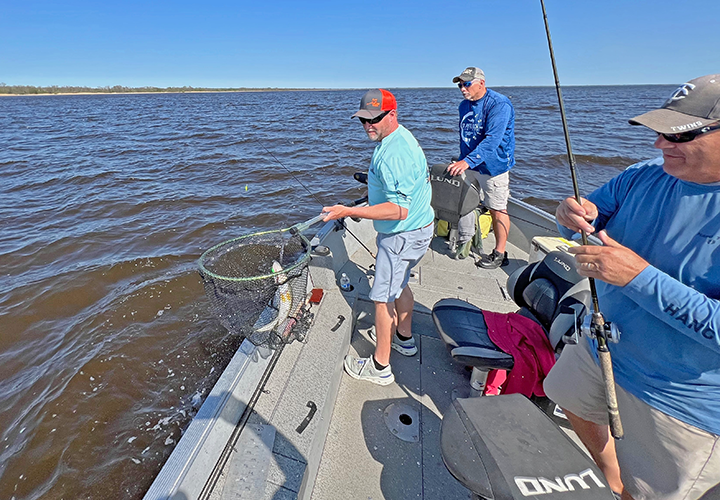 Fishing conditions in north central Minnesota are greatly improved this week. Sunshine, calm seas and warm air temperatures are transforming what were action-less fishing waters into vibrant ecosystems that are teaming with life. There are many reasons to be optimistic, but after almost 3 weeks observing cold water temperatures, seeing readings in the mid-60s is the most exciting.
Maybe the best fun I’ve had on Upper Red Lake in several years occurred on Wednesday. The big lake, which has been “fairly good” turned on, and for a few hours, walleyes were on a legitimate “hot bite”. On that day, the transformation occurred slowly, we observed fish populations in shallow water build hour-by-hour. During the morning, we chipped away at the walleyes, catching a keeper every 20 minutes or so. Sometime after 1:00 pm, the pace accelerated and by about 3:00 pm, my crew was boating 2, and sometimes 3 fish at a time.
I wasn’t there on Thursday, but based on conversations with friends, there was a similar pattern in play then too. Jason Alto, one of the more versatile guides in the Grand Rapids area, was there. Alto reported slow action early in the day, followed by a steady improvement during mid-afternoon. At one point, he found a spot where the action was good,
We speculated the notion that shiners, moving into shallow water as temperatures warmed, triggered a feeding movement. We pondered too that maybe it just takes a while to find the “right spot” for every new day. Either way, the trick for both of us was to not be discouraged by slower action early in the day. Instead, we used the time to explore, searching for areas that held baitfish, and by extension, walleyes. Only the fish know what triggers them, but over the years, I’ve seen the pattern play out many times,
I’m a jigger by nature; I love the feel of a walleye picking up a lure and tricking it into inhaling it. But I have to say that jigging is not the best way to search for fish. Covering water by trolling allows us to search for more territory faster. For me, trolling crankbaits was effective. After some experimentation, we settled on Berkley’s #5 Flicker Shads. Trolling in 5 feet of water, at 2.5 mph, we let out about 30 to 35 feet of line to get into the strike zone. Preferred colors, on that day, were lime-chrome, purple-tiger and fire tiger.
Trolling was effective for others too but not using crankbaits. There were several reports from folks using spinners tipped with either night crawlers or minnows and for them, the pulling blades worked equally well. I would have tried spinners, but honestly, didn’t have the necessary gear packed. The next time I visit the lake, I’ll be sure to try them and offer a firsthand report.
Theoretically, we could have stopped the boat and fished with jigs and minnows after location had been determined. We watched several other groups catching walleyes by anchoring and jigging. My assessment is subjective, but it appeared to me that the fish they were catching averaged smaller in size. An observation by a friend supported that theory, and it’s something to think about on your next trip. Either way, I think you can use your favorite presentation and probably do just fine.
I’ll have more about Red Lake soon enough, but before I run out of time, I want to mention yesterday’s fishing trip. Fun with Dick and Paul, 2026 spring trip is under way, and we started off the 5-day stint with a nice day on the lake. For me, a little more wind might have been nice, but it was gratifying to fish a small lake, find walleyes in the cabbage, and catch some of them.
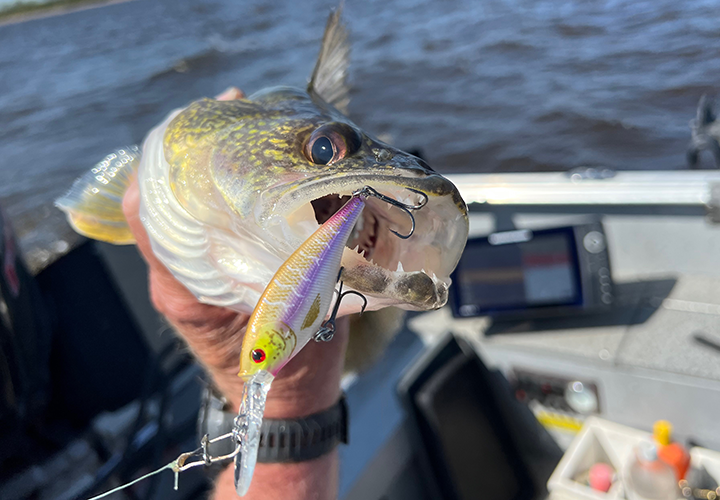
The action wasn’t gangbusters, but it wasn’t bad either. We managed to add 3 walleyes to the larder for their trip home. We harvested 5 walleyes, smaller fish, for our fish fry at the Outpost, and tossed back a few smaller fish as well. Jigs and minnows worked well for us early in the day, maybe until about 1:00 pm. After that, the northern pike woke up and once they did, we couldn’t keep them off of our hooks. Mostly small, 14-to-20-inch fish persisted to the point that I gave up on minnows and rigged up a wiggle worm. Pictured here, my first wiggle worm walleye of 2026 was followed by a few more too. I can’t say that using the night crawlers was the best presentation, I can only say that it did help fend off attacks with the small pike.
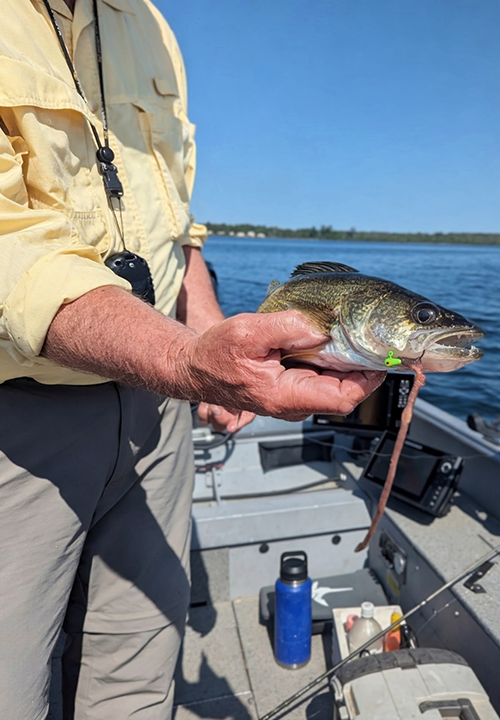
The key depth for us was about 8 to 10 feet, just outside the edges of sparse patches of cabbage. There were a few shallower fish too, located in about 5 feet of water along the outer edges of bulrush patches. Making long casts toward the structure and using a hop-drop-hop-drop retrieve triggered those fish.
When surface temperatures pushed into the mid-60s, I spent a little time looking for panfish. In that time, I didn’t find them, but my sense is that there will be crappies moving shallow very soon. We’ll be checking for them again in the coming days, and whatever we learn, I’ll share with you.
If you’re headed for the lakes this weekend, good luck out there! Pack your sunscreen and a wide variety of baits. I think there will be a lot of options for folks who enjoy experimenting with lures and presentations.
May 23, 2026 "Upper Red Lake Shiners Moving In, Walleyes To Follow"
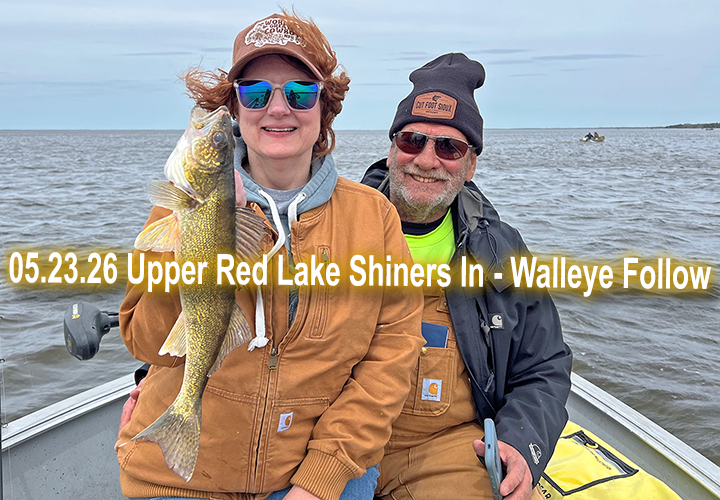 Upper Red Lake hasn’t received too much positive press over the past several days. That said, neither have the weather conditions over most of north central Minnesota. Experienced walleye anglers on Upper Red know that it’s not unusual for Minnesota’s largest lake to suffer when its waters are churned up by big blows. Earlier this week, constantly changing wind directions, cold temperatures and large whitecaps really did “muddy the waters” on the accessible sides of the lake; that’s the bad news.
On Wednesday, and again on Thursday, winds shifted to the southeast and were more subdued. Added to that, sunshine dominated the skies, which helped raise surface temperatures into the mid 50s. As the water began to warm up, more minnows moved shallow along the southeast shoreline. On Friday morning, I offered an update from Chad Benson who reported spottail shiners moving into his minnow traps on Thursday afternoon. While all that was happening, my optimism about catching walleyes on Red Lake grew.
On Friday morning, I took a calculated risk that calmer seas and the minnows migrating into shallow water would improve my odds of bringing home some keepers with my charter. The pressure was on now, because despite dismal reports, I’d buck the odds and make the long drive with my friend John Benton and his inamorata, Angie.
Honestly, I was prepared to offer the duo a free trip if my optimism was unwarranted. Luckily, that didn’t happen because while the fishing wasn’t stellar, it wasn’t bad either. We did amass their limits, 10 walleyes in the keeper size range. Along the way, we caught and released another dozen fish, mostly over-sized ones, but a couple of little ones too.
When we arrived at a quieter than expected Roger’s Campground, the sky was mostly cloudy, but not dark. The southeast breeze was stiff, but because it was blowing offshore, didn’t stir up and large waves. The water clarity, while not great, wasn’t bad not bad either. It appeared very typical compared to my past trips up there. Surface temperatures ranged between 53 and 55 degrees depending on the areas we fished. That was a bit cooler than I expected but represented an improvement from even colder readings on other lakes in my region.
 Presentations that worked best for us were both trolling crankbaits, and jigs tipped with golden shiners. Because I needed to search for fish, trolling was the first on the list. I traveled several miles, working shallow running crankbaits in water depths of 4 to 8 feet. At first, the action was slow, and I had lots of time to swap colors, sizes and shapes of the lures were tried.
After a lot of experimentation with colors that failed, we figured out that #5 Flicker Shads, both Fire Tiger and Lime Chrome worked for us. The best depth range for trolling was 7 to 8 feet deep, and for crank baiting, the shallow 4-to-6-foot deep breakline was unproductive. Trolling speeds varied, but I think the best range for triggering strikes was 2.4 to 2.6 mph.
After we’d caught a few fish, and I thought I had a small school pinned down, we stopped the boat and tried jigging. John caught a keeper almost immediately, Angie had a few missed strikes, and it looked like we were on the right track. Soon though, the action fizzled out and we decided to go back to trolling. For Angie, trolling was the preferred method, but now the action slowed down for John. Periodically, we switched back to jigging, allowing him to catch up, and then resumed trolling.
I didn’t see many folks catching fish on either jigs, or by using slip floats. But of the ones I saw, anchoring on the shallow breakline in about 4 feet of water and pitching toward deeper water seemed the most productive. One fisherman caught several walleyes as we chatted, and his success tempted me to spot-lock in the area. Our trolling was working though, especially for Angie, and I didn’t want to break the momentum. If I was going back again today, I’d definitely spend some time slowly jigging from an anchored position.
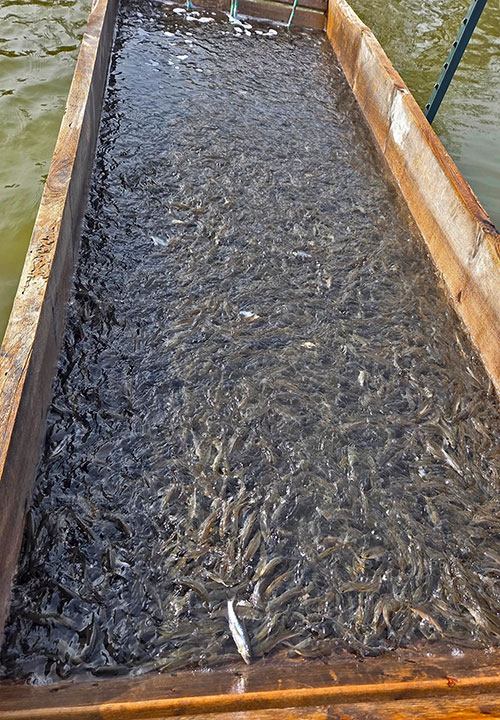 The shiners that we reported on yesterday did in fact make a move into shallow water. The image of this batch you see pictured here was delivered to me via text message at 11:00 AM on Friday. The lion’s share of those spottails were destined for the Northwoods Bait and Tackle in Bemidji. River Rat Bait in Cohasset was slated to receive some of them too, about 20 gallons or so. After that, Benson’s remaining inventory was to be delivered to other shops in the Cass Lake area.
The future of shiner supplies coming from Upper Red Lake depends on what happens today, and on Sunday. Unless the DNR makes an exception, all of the minnow traps and related gear on zebra mussel infested waters must be removed by Memorial Day Monday. That’s right, this is the deadline for all minnow trapping on Upper Red.
Shiner trappers on most other infested lakes have been struggling, on Lake Winnibigoshish, for example, far less success has been found. Deer River area bait shops depending on that lake for shiners have been rationing whatever supplies they currently have. Depending on what happens on infested waters today, the situation is unlikely to improve.
For other “non-infested” lakes, there’s still time for trappers to capture minnows. In all likelihood, supplies from those waters will arrive at the retail shops in a week or so. This year, anglers may well be in need of those supplies because cooler than average water temperatures will probably extend the jig and minnow season. More on that as events unfold.
Like many of you, I’m taking some time to enjoy my family this weekend. So, unless there’s breaking news, or pressing questions from readers, I’ll hold off on writing a report for Sunday morning. If you’re headed to the lakes this weekend, good luck out there! — Jeff Sundin, The Early Bird Fishing Guide Call-Text 218-245-9858 • Email • Facebook • X • Subscribe Insider Newsletter
 Wired2Fish May 23, 2026 "Master Shallow Topwater Fishing | Justin Lucas’s Tips"
 "Covering Water With Topwater Lures. One of the biggest advantages of shallow topwater fishing involves efficiency. Lucas explains how covering water quickly can help anglers break down unfamiliar lakes and locate aggressive bass faster. Reed lines, shallow grass and isolated cover can all produce bites throughout the day. Small openings and irregular edges along the cover create key ambush points for feeding fish. Accurate casts play a major role in generating strikes. Fish will commit close to the boat after the bait moves through narrow lanes and shaded areas.
Why Sound Matters. Sound can become a major trigger during a shallow topwater bite. Lucas discusses how subtle squeaking and surface disturbance can draw aggressive reactions from bass in calm conditions. Low-light periods produce some of the best action because fish have to rely heavily on sound and silhouette. Darker bait colors and louder surface presentations are especially effective. Lucas also explains how weather conditions can influence the bite. Calm water allows fish to track the bait more easily, while light wind helps disguise the presentation and improve casting distance and ..." View Video and Learn More >> Master Shallow Topwater Fishing | Justin Lucas’s Tips
Today's Feature Fishing Report: Jeff Sundin - May 15, 2026 "Discovering the Discover-Able on Upper Red Lake"
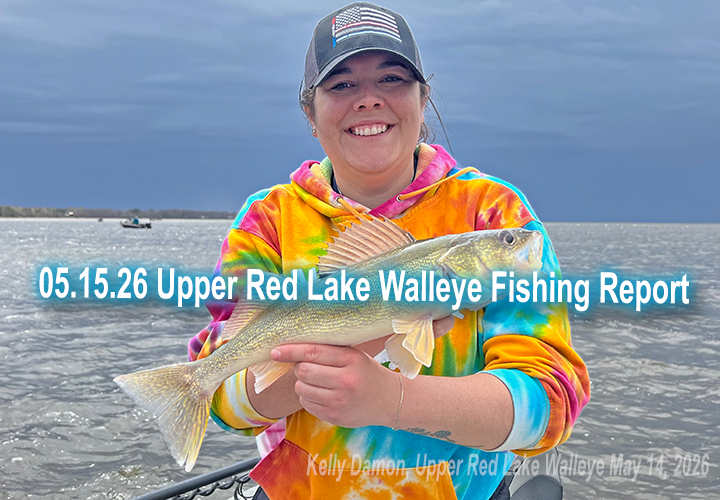 Before Thursday, I hadn’t fished on Upper Red Lake yet this season. Several of my friends had already fished there and offered me guidance. Some advice about the methods they’d used to catch walleyes was very specific.
One of them arrived there last Monday, prepared to catch fish on jigs and minnows. “We drifted, trolled and fan casted using the jigs, but weren’t catching that many fish. We saw a couple of folks anchored up and catching walleyes using bobbers. As soon as I stopped my boat and set up my crew with bobbers, we started catching fish left and right. I’d say the catch ratio was 5 to 1 bobbers vs jigging.
In another conversation, the advice offered was about a fishing trip on Wednesday. “When we got to our favorite spot, we spot-locked the boat and rigged our lines up with slip-floats and jigs, tipped them with lively rainbows and fan-casted the surrounding area. We did catch a few fish, but we could see other guys trolling with crankbaits and they were doing better. I rigged up my crew with crankbaits and when we started trolling, we caught a lot more fish. I wish I’d been trolling from the beginning of our trip; we would have done a lot better.” He advised.
Okay, so on Wednesday evening, I’m preparing to take my crew up there the next morning. Naturally, I go to the tackle shop and stock up on bobbers and shallow running crankbaits. I don’t want to get caught off guard, so I buy plenty of both.
On Thursday morning, my crew and I begin the trip trolling crankbaits. Flicker Shads, Husky Jerks, shallow running rebels, Salmos, a little bit of everything. We caught a couple of fish, but it was clear that today, trolling hard baits was not the magic solution. My next move would be fishing with bobbers but first, I wanted to locate a spot with good potential. So, to explore the shoreline, I set my crew up with 1/8-ounce jigs and nice sized fatheads. We drifted along the breakline in water depths of 4 to 7 feet in search of a likely spot.
Within minutes, Kelly caught a nice walleye and not long afterward, she followed that with another one. Then I caught one, and then Kelly caught her 3rd one. Long story short, drifting with jigs worked well enough for us that we used that presentation for the rest of our trip. So, all of my stocking up on cranks and bobbers was basically unnecessary, at least for that day. The takeaway for folks headed to Red Lake in the coming days should be to prepare several presentations and be ready for experiments.
The water temperature was cold, 49 degrees during the morning hours, rising to just over 50 degrees by late afternoon. Baitfish began appearing on the screen of my graph late in the day, but even then, small, scattered schools of minnows were the norm. I never observed any of the giants clouds of shiners that we sometimes see along the shore.
The water clarity was poor, strong winds stirred the lake up and visibility was maybe 18 to 24 inches, not much better. Unfortunately, there’s a brisk and gusty west-southwest wind in today’s forecast. If that prediction comes true, it could make for a tough day on the lake. Historically, it takes the lake a day or two to settle down after a big blow, so even the weekend action could be hampered.
The fish we caught were of surprisingly good quality. There were a good number of fish in the 15-to-16-inch range, and not very many really small fish. There are a very healthy number of larger fish, over 17 inches. At the fish cleaing station, we heard reports of folks catcing fish up to 24 inches. Joyce caught our best walleye measuring 21 inches. Because of the current regulation, 1 fish over 17 inches, we were required to release a dozen or so, over sized walleyes. That didn’t stop us from harvesting a legal limit of fish, but it did take all day long to sort through the herd, and capture enough 15 to 16 inch fish to fill liits for the crew.

For me, the longer-range outlook for Upper Red is good, and I’ll plan another trip up there as soon as the weather becomes more stable. Without doubt, I'll have more updates for you in the near future.
You Are Invited To Become A Duly Deputized Fishrapper Cub Reporter
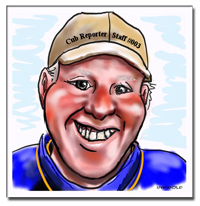 If you've been waiting for a gold engraved invitation to participate in the daily reports, then stop waiting and consider this your own personal invitation.
Helping your fellow fishermen and women stay abreast of fishing conditions in your area is good for everybody and it's easier than you think! You don't have to write a book, you don't have to share your secret fishing spots and you don't even have to mention your lake. But even a few words about general trends, seasonal patterns and local weather conditions can really help.
Be like me, become a duly deputized "Cub Reporter", it's good for fishing! Contact Us or if you prefer to be "social", Fishing Reports Minnesota, the Facebook counterpart to this page is open to the public, so you can post your own fishing update or just share a photo of a nice catch.